Message in a Bottle: A research-informed classroom ritual to build hope
A hope-based writing and creative practice grounded in two decades of psychological research
Yesterday I shared a flashback from 2015. A classroom activity I created for a group of Year 13 girls stepping into their final year of school.
What I didn’t expect was the response. Within hours, teachers were messaging to ask if they could use the activity with their own students. Former students sent me photos of their bottles, still sitting on shelves in their flats and homes, unopened, years later. Others shared how much the experience had stayed with them long after they left school. They clearly loved their bottles.
In many ways, they had become a kind of message in a bottle — a private note to their future selves, sealed with hope and possibility.
Where it began
I originally created this activity for the senior students at Abi’s school. It was the start of their final year, their last stretch before leaving school and stepping into adulthood.
Walking back into that environment without Abi was one of the harder things I’ve done. I’d only ever been there as her mum. But I also felt a strong pull to show up for those girls and to create something that might encourage them, urge them forward, and open doors to their possible future. I care deeply about empowering women and girls, about helping them recognise their uniqueness and their capacity to shape their lives. So I made myself do it.
What emerged that day was a ritual built around hope, imagination, and meaning.
Research led, with a unique twist
The activity was inspired by psychologist Laura King’s best possible future self intervention — a writing-based exercise developed and tested through over two decades of rigorous research.
Participants are invited to imagine themselves in the future, having lived in ways that align with their deepest values and goals, where life has unfolded “as well as it realistically could”. They then write about this future in vivid detail, free form and uninterrupted, for 10–15 minutes.
The research showed that this process reliably increases hope, optimism, positive emotion, motivation, and wellbeing. It helps people clarify what matters to them, strengthens their sense of agency, and increases goal-directed behaviour. What’s not to love?!
At a psychological level, imagining a meaningful future activates powerful motivational systems. When people can picture themselves living into their values, they become more willing to invest effort, tolerate discomfort, and persist through difficulty. Hope becomes something embodied, something they can work on, rather than abstract.
For adolescents standing at the threshold of adulthood, this kind of future-oriented thinking can be particularly potent.
Why I adapted it - my take on a good ‘intervention’ that needed a more personal twist!
Rather than leaving the exercise in written form only, I wanted to transform it into something tangible, beautiful and symbolic.
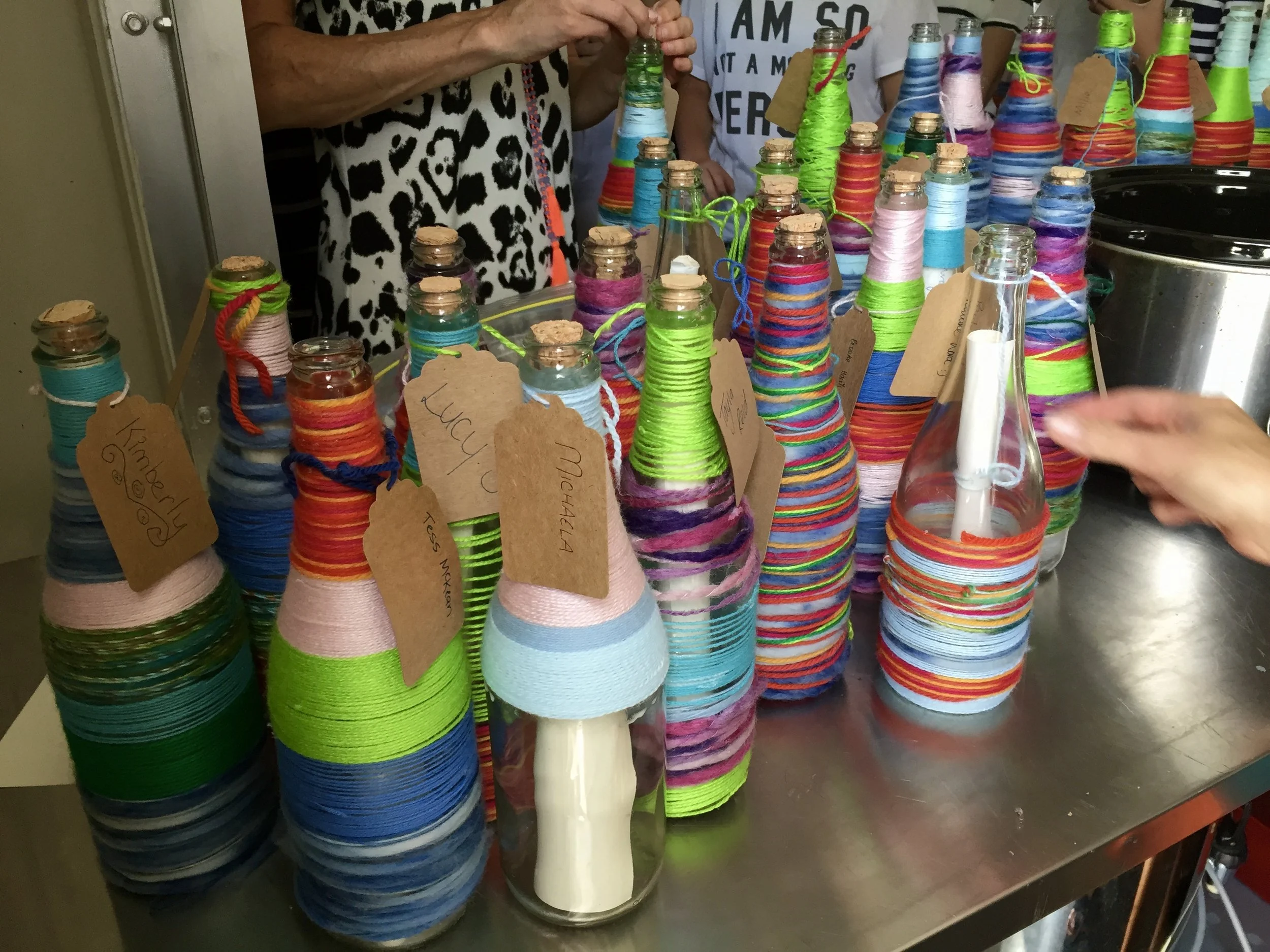
After writing their confidential letters to their future selves, each student was given an empty bottle, glue, and heaps of brightly coloured wool. They wrapped and decorated their bottles freely, encouraged to go wild and do what they liked.
The results were extraordinary. Every bottle was strikingly different: some precise and restrained; others were exuberant, chaotic, playful, layered, messy or bold. As the bottles began to line up across the tables, the visual message became unmistakable. There is no single way to be. There is no correct design for a life. That moment allowed me to remind them that their individuality is something to honour, not to crush or dampen.
With the letters safely inside, each bottle was corked and sealed with melted wax. That step mattered to me: I needed the wax to create a sense of privacy and protection, allowing students to write honestly, to think expansively, and to dare to dream, without fear of being judged.
[It did mean sacrificing my own family slow cooker to repeated rounds of melting wax, but that felt like a small price to pay.]
Why the ritual lasts
The bottles weren’t designed to be opened quickly. I suggested students wait. Maybe even a decade down the track. That delay introduces anticipation, reflection, and perspective.
Over time, I’ve had the enormous pleasure of seeing these bottles appear again: sitting on shelves in student flats, tucked into bedroom corners, mostly still sealed. Former students have sent photos across the years, reminding me that their bottles are still somehow symbolic, still travelling with them.
I love the way these bottles have become physical anchors of identity, hope, and possibility - messages in a bottle, quietly waiting for the right moment.
Why I’m sharing this now
After yesterday’s post, several teachers asked if they could use the activity in their own classrooms, some families wanted to use it to wrap up the end of the holidays, before the start the next school year.
Which prompted me to write this blog, and to create a downloadable outline so you can use this activity in your classroom, with your youth group, or simply at home.
Young people today are navigating extraordinary levels of uncertainty, pressure, and change. They are being asked to make significant life decisions in a world that feels increasingly unpredictable. Helping them cultivate hope, agency, and future orientation is not a luxury right now - but is essential.
My hope is that this ritual continues to invite students to think expansively, to honour their individuality, and to imagine lives that feel hopeful to them, even when the path ahead feels unclear. That they continue to dare to dream.
This focus on hope and future-oriented coping is something I explore more deeply in my new book, How Will I Ever Get Through This?, where I look at how we adapt, find meaning, and keep going when life unravels.
Sealing hope
If you’ve followed my work for some time, you’ll know there is a line from a Mary Oliver poem that I often return to:
Tell me, what is it you plan to do with your one wild and precious life?
Sometimes this has been the question I’ve posed to students. I love the breadth of possibility it invites. I hope it creates space for young people to reflect honestly, privately, and look forward with anticipation and courage. In my mind this is not about creating perfect lives, but taking a few steps towards considering what matters, who we are and who we want to be.
If this blog speaks to you then you might like to follow me on socials (@drlucyhone) or sign up for my newsletters below. I’m continually on the hunt to find ways to make this one and wild precious life as good as we can - with what we’ve got, given whatever we are facing.