How to listen to your feelings without letting them decide.
I’ve spent the last three days feeling slightly on edge. A feeling I could only manage to describe as angsty.
What’s going on here, I thought? Because that’s what we’re supposed to do when strong or unexpected emotions appear. That’s what I teach other people. And it’s what I’ve taught myself to do too.
Why was I feeling so on edge?
What’s going on is that the Airbnb I’d booked for this week in Sydney was shared accommodation. Shared. With a man, called Craig.
I’m a reasonably adventurous traveller and have had successful shared accommodation before through Airbnb. But that was owned by a woman. And I was with my husband. This time I’m alone, with Craig.
I’d checked Craig out - a Qantas pilot who uses it as his crash pad when flying in and out of Sydney. He has a granddaughter, he’s a pilot, he’s verified FFS. What are you worried about?! The obvious, obviously.
So, I fret a little. I wonder. I read and re-read the glowing reviews over and over. It’ll be fine I tell myself. The only thing being I’ve recently been working to support the resilience of the cybersecurity industry, which has truly heightened my awareness of scams, and how easily we are tricked.
If this profile was bogus - looking to attract unsuspecting women - how better to represent yourself than a trusted pilot in his mid-50s from Australia’s national airline.
I keep the booking. I trust that I’ll be arriving during the day and I can let my Spidey-senses decide for me. There are good signs. I’ll go with the good signs and trust in humanity. Let’s see how this goes. It might just be the best thing I’ve ever done: make a new friend in Sydney, find a new place to stay, discover a new neighbourhood.
When I arrive straight off the flight, 5 hours before the listed check-in, Craig’s there to meet me. He’s only in his pilot kit! Complete with security badge. I laugh. I help him make my bed (I’m early remember), he shows me around, offers to make me coffee on his Italian espresso machine, tells me to help myself from the fridge, provides fresh towels, and a beach towel and points me towards the beach, while he catches up on the sleepless night he’s had steering the A380 in from Singapore.
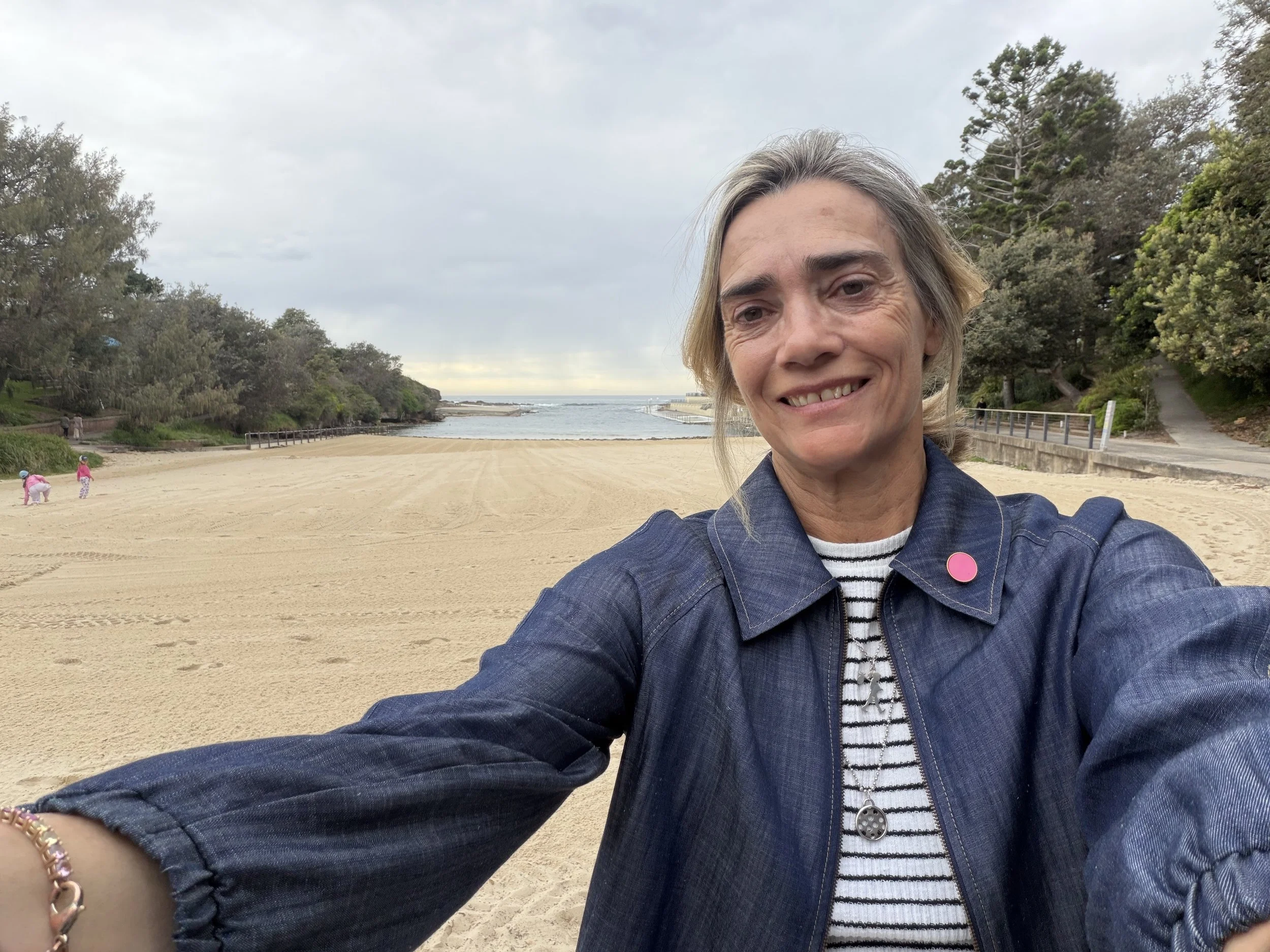
I took his advice and headed for the beach.
By then, I was beginning to wonder what I’d been so worried about.
So, now, here I am, 40 minutes later, sitting in a coffee shop that’s all new to me, feeling delighted. Yes, that’s right, delighted. From angsty and nervous to delighted and smug in one short successful hour.
Yes it could have gone wrong. Yes it still could - the lock on my room is a long way from a deadlock - but, here I am with Craig’s keys in my pocket, reminding myself that emotions are data: information sent to tell us there’s something worth paying attention to here.
What does it mean that emotions are data?
Have you heard that before? That emotions are data? They’re information about how we’re responding to what’s happening, what we think might happen, and what matters to us. They’re worth paying attention to. But a feeling, however strong, isn’t proof that our interpretation is right.
As psychologist Susan David neatly puts it: “emotions are data, not directives.” Our feelings can inform what we do without deciding it for us.
Fear, for example, can act as an alarm system, alerting us to a possible threat. But an alarm isn’t a verdict. We still need to look at what’s setting it off.
Hence, my angsty feelings were doing a good job of alerting me to the potential danger of Craig being a bad guy.
How can we check what our feelings are telling us?
Given I understood that, I looked at the thought behind the feeling. What if Craig wasn’t who he said he was? A possibility worth checking. But what other interpretations fitted the information I had?
Maybe Craig was exactly who he said he was. A pilot who, potentially, just like me, welcomed opportunities to meet new people and keep broadening, not shrinking his life. The reviews were plentiful and reassuring. Arriving during the day would give me a chance to look around and decide how I felt about staying.
So far, that more reassuring interpretation fits what I’ve found. As a result, I’m left walking down to the beach feeling smug (I know it’s not an attractive admission, but I literally feel like I’ve got a bright “who dares wins” sign above my head). Life is good. People are good. Thanks emotions, you did your job. You prompted me to check things out. And with more information, the fear and worry have eased.
What to do when strong emotions show up
The main things I want you to take away from this are these:
Notice the feeling. Angsty? Angry? Sad? What’s going on here? Try naming what you’re feeling before deciding what to do about it.
Listen to what it might be telling you. Is there a possible danger to check out? Something you care about? An expectation that’s been unsettled?
Check your interpretation. What do you actually know? What are you assuming? What else could explain what’s happening? Get more information or seek counsel from sources you trust.
Choose what to do next. Sometimes the feeling is pointing to something that needs action. Sometimes you need more information. Sometimes, after checking, you can let the alarm settle. You don’t have to talk yourself out of a concern to prove you’re resilient.
And remember, the emotions you feel today are unlikely to be exactly what you feel in the future. Circumstances change. We get more or better intel. Emotions come and go.
From angsty to delighted in one short hour. With all the awfulness and things to worry about in the world right now, I found it hugely comforting to land in a little corner of Sydney where someone I’d never met treated me with such kindness. Craig made me feel welcome from the moment I turned up, five hours early. Thank you, Craig.
One small green tick for this crazy scary world.
Three tools to help you get through hard times
When I’m feeling on edge, it helps me to have a good question to come back to. I’ve put three of my go-to questions in a free download for anyone dealing with uncertainty, challenge or change. They’re research-backed, I use them myself, and I’ve seen them help people get through tough times again and again. I hope they help you find your way to better days ahead.
Plus, I’ve created a downloadable free 'sensory toolkit’ full of practical ways to soothe yourself using your senses. There’s no perfect strategy for handling difficult emotions - try a few I’ve listed here and see what works for you.